• Events
  • Grants & Awards
  • Media
  • People
  • Research
  • Artificial Intelligence
  • Biomechanics
  • In-Vitro & Organs-on-Chip
  • Rehabilitation & Neural Engineering
  • Robotics
  • Surgical Technologies
  • Virtual & Augmented Reality
  • AIHN – AI in Health and Nutrition
  • AIMI – AI in Medical Imaging
  • ARSL – Acoustic Robotics Systems Lab
  • CBE – Computational Bioengineering
  • CVE – Cardiovascular Engineering
  • GER – Gerontechnology & Rehabilitation
  • HRL – Hearing Research Laboratory
  • IGT – Image-Guided Therapy (former)
  • MDP – Mechanical Production Workshop
  • MIA – Medical Image Analysis
  • MLN – Motor Learning & Neurorehabilitation (former)
  • MSB – Musculoskeletal Biomechanics
  • MSL – Medical Sensing Laboratory
  • NRG – Neuro Robotics Group
  • OOC – Organs-on-Chip Technologies
  • UGE – Urogenital Engineering

372 hits

Predicting screw fixation strength for fractured bones

In collaboration with the AO Research Institute Davos, the Musculoskeletal Biomechanics group has assessed three different strategies to determine the stability of screws used to fix bone fractures. In an experiment with human cortical bone specimens the team could show that explicit, nonlinear micro-finite element simulations captured fixation strength most accurately.

Research MSB – Musculoskeletal Biomechanics Biomechanics

16. December 2021
PeriVision wins EIT Wild Card 2021

PeriVision, a MedTech spin-off from the ARTORG Center (AI in Medical Imaging lab) has won a prestigious European Wild Card in the 2021 challenge. The Bernese startup will be receiving an investment of EUR 1.5M along with specific coaching, which the founders will use to finalize their first product and prepare its EU and US market launch. PeriVision wants to reimagine glaucoma patient monitoring by making visual field testing much more patient-friendly and cost-efficient.

Grants & Awards AIMI – AI in Medical Imaging Artificial Intelligence

15. December 2021

Influence of Task Instructions on Motor Performance

In neurorehabilitation, motor and cognitive aspects have been investigated and treated separately and seldomly been combined. The Motor Learning and Neurorehabilitation Laboratory, together with the Department of Neurology of the Inselspital, Bern University Hospital, and the Translational Research Center of the University Hospital of Psychiatry, have now evaluated in a study how written or visual commands influence motor performance and brain networks involved before and after training.

Research MLN – Motor Learning & Neurorehabilitation (former) Rehabilitation & Neural Engineering

09. December 2021

Minimal trauma in robotic CI implantation

During robotic cochlear implantation, an image-guided robotic system provides direct cochlear access to facilitate electrode array insertion. Aiming for a minimally traumatic approach, the Image Guided Therapy lab has recently proposed an extension of the robotic planning strategy to preserve the anatomical and functional integrity of critical intra-cochlear structures during robotic inner ear access.

Research IGT – Image-Guided Therapy (former) Robotics Surgical Technologies

07. December 2021

Electrode leads in robotic CI implantation

When a cochlear implantation (CI) is performed robotically, the surplus electrode lead cannot be stored in the same way as in the manual surgery. This is because in the robotic procedure, instead of an access cavity, only a small-diameter drill hole directly to the inner ear is created. In an alternative approach, the Image Guided Therapy lab has now proposed extending the robotic procedure to also mill channels for the electrode lead fixation. These channels are designed to hold the electrode in place and protect them from external trauma.

Research IGT – Image-Guided Therapy (former) Robotics Surgical Technologies

25. November 2021

RetinAI and Heidelberg Engineering announce collaboration

RetinAI Medical AG, a spin-off from the ARTORG AI in Medical Imaging Lab, and Heidelberg Engineering (HE) have announced a collaboration which will enable Heidelberg Engineering’s customers to utilize RetinAI’s portfolio of artificial intelligence analysis tools in combination with high-quality OCT images. This enables the users of a HE system to sending OCT volume scans for analysis using RetinAI’s tools in a convenient and secure manner.

Media Research AIMI – AI in Medical Imaging Artificial Intelligence

18. November 2021

New Hope for Broken Hearts

New Hope for Broken Hearts

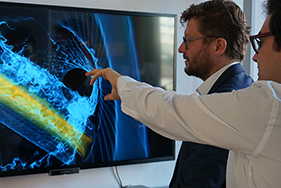
“We engineers are good at taking partial differential equations, translating them into computer programs, and getting them to run. But we lack an understanding of biological processes. We need to rely on experiments as much as simulations,” says Dominik Obrist in an interview with Hewlett Packard. He was asked about the Cardiovascular Engineering group’s project of designing non-turbulent artificial heart valves with the help of fluid mechanics experiments and supercomputing simulations.

Media People CVE – Cardiovascular Engineering Biomechanics

17. November 2021

Zukunftstag - Girls - Technology - Go!

This year’s National Future Day contribution by the ARTORG Center will introduced girls to a career in surgical technologies R&D, robotic neurorehabilitation, and organs-on-chip research. The program runs under the special focus Girls – Technology – Go! and is designed to attract girls to technical professions and to inspire them as future female leaders in medical technology.

Events IGT – Image-Guided Therapy (former) MLN – Motor Learning & Neurorehabilitation (former) OOC – Organs-on-Chip Technologies In-Vitro & Organs-on-Chip Rehabilitation & Neural Engineering Robotics Surgical Technologies Virtual & Augmented Reality

11. November 2021

PhD thesis defense Maria Vasiloglou

The ARTORG Center congratulates Maria Vasiloglou, Artificial Intelligence in Health and Nutrition (AIHN), for successfully defending her PhD thesis on 27 October 2021! For her PhD project “Design and validation of a dietary monitoring and assessment system based on machine learning and computer vision” Maria has assessed how well image-based food apps can calculate individual nutrient intake, which input mistakes users are most prone to make, what the opinions of healthcare professionals and end-users on nutrition apps are, and how Artificial Intelligence can measure adherence to Mediterranean Diet.

People AIHN – AI in Health and Nutrition Artificial Intelligence

01. November 2021

Fathoming Visual Neglect

The neuropsychological attention disorder Visual Neglect can occur after brain lesions. However, it is difficult to establish a precise cause-effect correlation between the injured brain regions and the occurrence of this disorder. In a research letter in JAMA Neurology researchers from the ARTORG Center, Inselspital and Luzerner Kantonsspital now describe a patient case that could shed more light on the possible origins of the hemiplegic perception deficit.

Research GER – Gerontechnology & Rehabilitation Rehabilitation & Neural Engineering

28. October 2021