02.06.2026 | People | Biomechanics
PhD Defense: Gabriela Gerber Proposes Frameworks to Improve Computational Bone Modelling
On June 02, 2026, Gabriela Gerber successfully defended her PhD thesis: “Computational Modelling of Bone Across Multiple Time-Scales: From Immediate Rate-Dependent Behaviour to the Estimation of Long-Term Loading History.”
In this thesis, Gabriela addressed issues of oversimplified models in computational modelling of bone, and presented two modelling frameworks which allow to improve model accuracy by considering relevant structural features and constitutive characteristics across multiple time-scales.
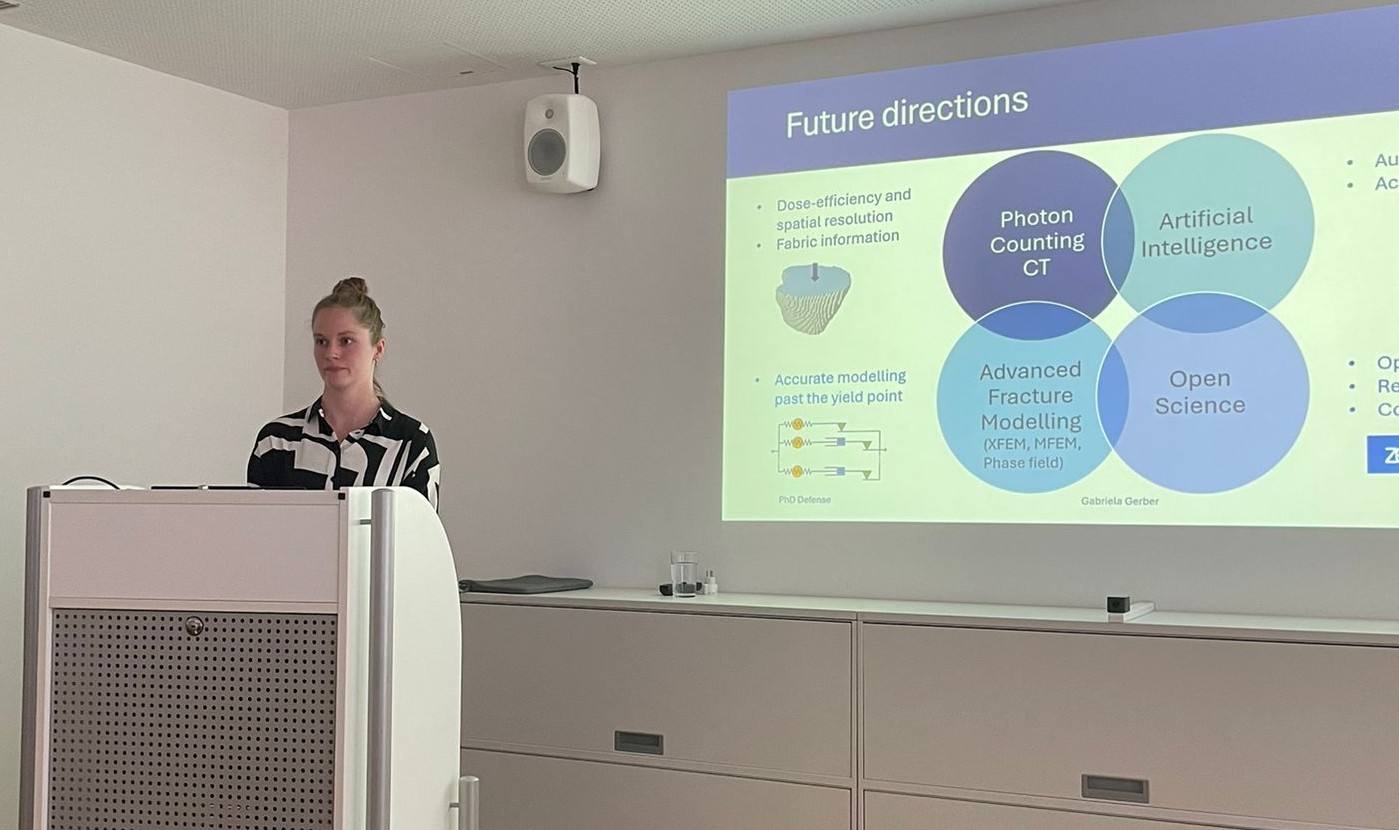 Gabriela Gerber at her thesis defense.
© Gabriela Gerber
Gabriela Gerber at her thesis defense.
© Gabriela Gerber
Bone is a living tissue characterized by a complex hierarchical architecture, remarkable mechanical properties and the ability to adapt to its environment. Computational models of bone using the finite element method provide valuable tools for complex biomechanical analysis in research and clinical settings but are only useful if they capture all relevant characteristics of the system of interest.
In a first project, Gabriela developed, implemented and validated a viscoelastoplastic material model, capable of capturing the instantaneous tissue response to loading across eight orders of magnitude in strain rate, substantially improving the quantitative agreement between simulated and experimental mechanical outcome measures compared to strain rate-insensitive material models.
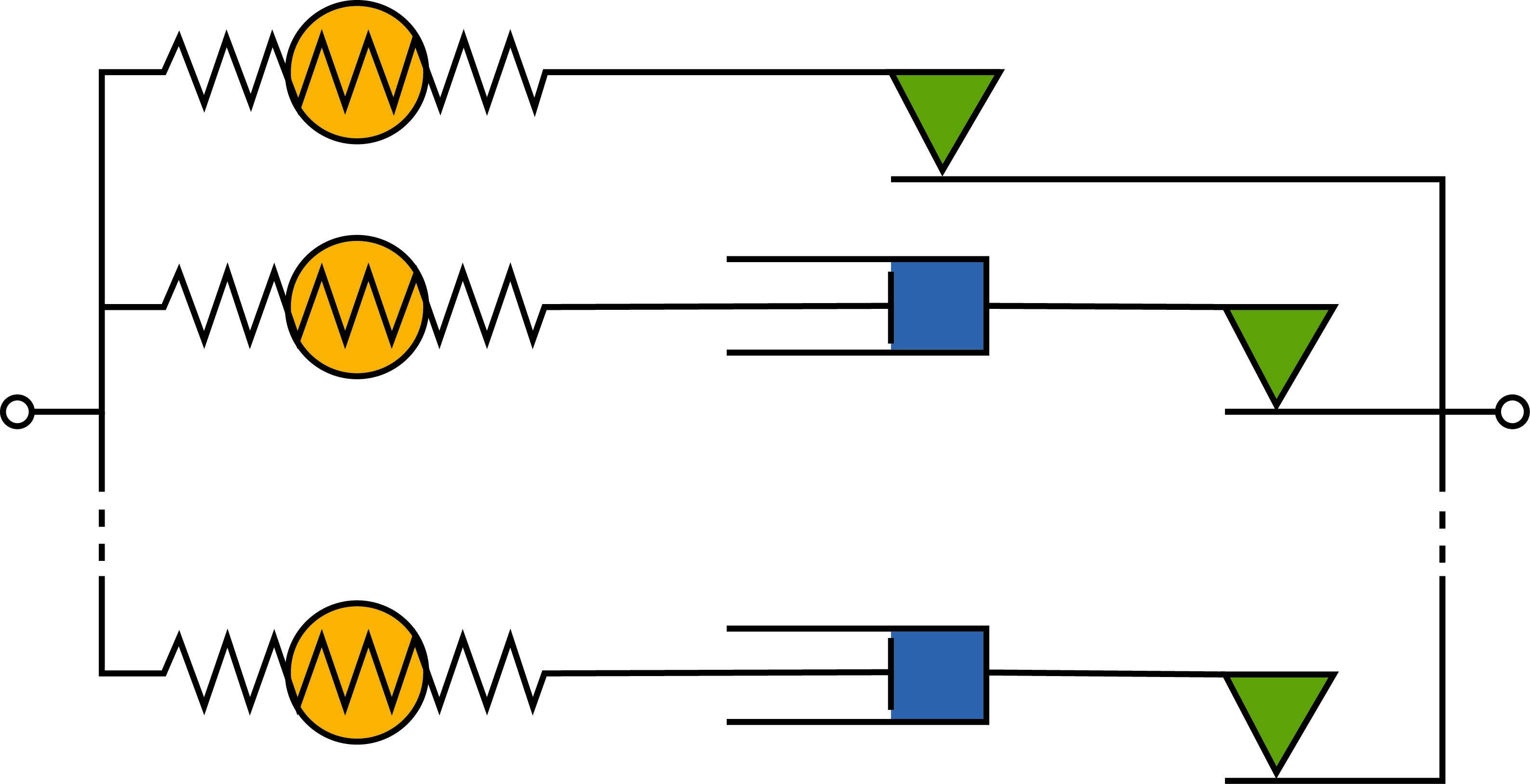 Visualization of the viscoelastoplastic constitutive model for bone consisting of damageable elastic springs, viscous dashpots and plastic sliders suitable for applications under quasi-static experimental conditions, activities of daily living and low-impact fall scenarios.
© Gabriela Gerber
Visualization of the viscoelastoplastic constitutive model for bone consisting of damageable elastic springs, viscous dashpots and plastic sliders suitable for applications under quasi-static experimental conditions, activities of daily living and low-impact fall scenarios.
© Gabriela Gerber
In a second project, she focused on the inclusion of both microstructural orientation and local bone volume fraction in homogenized inverse remodeling algorithms for the estimation of long-term average loading conditions in bone, which she found improved the fit between load case estimation and bone architecture.
Further development and validation of these two frameworks may allow addressing current clinical challenges in the field of fracture risk prevention, the estimation of in vivo loading conditions, and bone adaptations following surgical interventions or changes in lifestyle.
Congratulations to Dr. Gabriela Gerber on this incredible achievement and for advancing the utility of computational modelling of bone tissue!