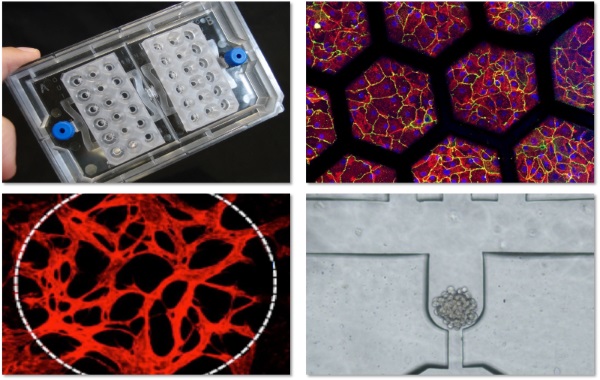
Organs-on-Chip – Advanced In Vitro Models for Lung Disease and Cancer Research
The Organs-on-Chip Technologies Laboratory develops next-generation microfluidic organ models focusing on lung physiology, respiratory diseases, and cancer. With over 15 years of expertise, our group pioneers next-generation biological lung-on-chip systems and vascularized tumor-on-chip models that closely replicate human tissue architecture and function.
Our interdisciplinary approach combines microfluidics, microfabrication, tissue engineering, material sciences, and clinical collaboration with the Pulmonary Medicine and Thoracic Surgery Departments at Inselspital, University Hospital of Bern. This unique positioning enables translation from bench to bedside and supports our spinoff AlveoliX in bringing lung-on-chip technology to the preclinical pharmaceutical market.
Our Technology Platforms
Next-Generation Biological Lung-on-Chips
- We developed an advanced breathing lung-on-chip featuring life-size alveoli in a stretchable biological membrane composed of collagen and elastin—making it the first fully biological lung-on-chip without synthetic polymers. This system replicates the ultra-thin air-blood barrier with three-dimensional cyclic mechanical strain from breathing motions, providing unprecedented physiological relevance for drug testing and disease modeling. Check our highly cited article: Zamprogno et al. 2021; Weber et al., 2025.
- We pioneered the combination of organoid technology with organ-on-chip platforms by growing patient-derived alveolospheres, dissociating them, and seeding them on-chip for functional studies and transcriptomic analysis. This approach enables personalized disease modeling with primary patient cells in a physiologically relevant microenvironment: Hajari, Schulte et al. 2025.
Vascularized Tumor-on-Chip Models
- Our tumor microenvironment models integrate perfusable microvascular networks with patient-derived cancer cells to study tumor progression, metastasis, and drug response. These systems enable investigation of cancer-endothelial interactions, immune cell infiltration, and therapeutic efficacy in a controlled 3D environment. (Schmid et al, 2024)
Functional Lung Microvasculature
Inhalation and Aerosol Exposure Systems
- Together with AlveoliX and Alexis Technologies we further develop inhalation models. Our integrated platforms combine breathing mechanics with controlled exposure to aerosols, cigarette smoke, and inhaled therapeutics, providing realistic models for inhalation toxicology and pulmonary drug delivery research. (cigarette smoke exposure: Sengupta et al. 2025; aerosol toxicity: Sengupta et al. 2023)
Research Focus Area
Cancer Research
- Vascularized lung tumor models for studying metastasis and angiogenesis
- Patient-derived tumor-on-chip for personalized oncology
- Cancer-immune cell interactions and immunotherapy testing
- Drug screening with tumor microenvironment complexity
Respiratory Disease Modeling
- Idiopathic pulmonary fibrosis (IPF-on-chip)
- Chronic obstructive pulmonary disease (COPD)/emphysema
- Infectious disease models (bacterial and viral pneumonia)
- Rare lung diseases with patient-specific cells
Inhalation Toxicology & Drug Delivery
- Cigarette smoke exposure and COPD pathogenesis
- Nanoparticle toxicity in lung tissue
- Inhaled therapeutic delivery and efficacy
- Environmental pollutant effects on respiratory health
Precision Medicine Applications
- Patient-specific disease modeling using primary cells
- Personalized drug screening for therapy selection
- Biomarker discovery in relevant tissue context
- Reducing animal testing through human-relevant models